

Quick answer: The correct way to compare quotes is not just to look at the final price. You need to check the type of boat, actual sailing hours, port of departure, fuel, skipper, capacity, extras, cancellation policy, and sales service.
Contents
Comparing boat rental quotes seems simple until you discover that two similarly priced offers can include completely different experiences. In a market like the Costa del Sol, where tourist boats, premium yachts, group catamarans, and very different private experiences coexist, making a decision without a plan often results in friction, unrealistic expectations, or wasted money.
This article aims to address the true purpose behind searches related to comparing boat rental quotes on the Costa del Sol. The goal isn't to provide a generic answer, but rather practical guidance to help you decide whether you're considering a trip to Fuengirola, Málaga, Benalmádena, Marbella, or Puerto Banús.
What you should understand before making a decision
When a user visits a nautical service website, they're almost never just looking for a boat. They're looking for a specific outcome: to celebrate something, to unwind, to impress, to spend time with their group, to have a comfortable outing, or to avoid a costly mistake. That's why the best purchase isn't based on a pretty product description or a low price. It's about understanding which experience truly fits the customer's needs.
At Yacht Pro Spain, the right decision is usually based on four layers: group profile, vessel type, port of departure, and actual service conditions. If one of these layers isn't well-defined, the user makes inaccurate comparisons, asks the wrong questions, and ends up evaluating offers that aren't equivalent.
The factors that have the most influence
These are the factors you should carefully review before booking:
- Type of vessel and actual size. Evaluate this point in relation to the plan's objective, not in isolation.
- Effective duration of the outing. Evaluate this point in relation to the plan's objective, not in isolation.
- Whether it includes a professional pattern or not. Evaluate this point in relation to the plan's objective, not in isolation.
- Fuel, cleaning and port fees. Evaluate this point in relation to the plan's objective, not in isolation.
- Extras such as paddle surfing, drinks, music or catering. Evaluate this point in relation to the plan's objective, not in isolation.
- Season, schedule and port of embarkation. Evaluate this point in relation to the plan's objective, not in isolation.
Type of vessel and actual size: This factor directly influences the perceived quality of the experience. When properly analyzed, it helps avoid misleading comparisons and allows for clearer decisions between various options. In practice, many satisfaction problems arise because this point was left until the end or assumed without verification.
Effective duration of the outing: This factor directly influences the perceived quality of the experience. When properly analyzed, it helps avoid misleading comparisons and allows for clearer decisions between various options. In practice, many satisfaction problems arise because this point was left until the end or assumed without verification.
Whether it includes a professional pattern or not: This factor directly influences the perceived quality of the experience. When properly analyzed, it helps avoid misleading comparisons and allows for clearer decisions between various options. In practice, many satisfaction problems arise because this point was left until the end or assumed without verification.
Fuel, cleaning and port fees: This factor directly influences the perceived quality of the experience. When properly analyzed, it helps avoid misleading comparisons and allows for clearer decisions between various options. In practice, many satisfaction problems arise because this point was left until the end or assumed without verification.
Extras such as paddle surfing, drinks, music or catering: This factor directly influences the perceived quality of the experience. When properly analyzed, it helps avoid misleading comparisons and allows for clearer decisions between various options. In practice, many satisfaction problems arise because this point was left until the end or assumed without verification.
Season, schedule and port of embarkation: This factor directly influences the perceived quality of the experience. When properly analyzed, it helps avoid misleading comparisons and allows for clearer decisions between various options. In practice, many satisfaction problems arise because this point was left until the end or assumed without verification.
Common mistakes to avoid
Most bad decisions don't stem from a lack of options. They come from poor comparison or booking too hastily. These mistakes are repeated time and again in the nautical sector, and it's worth being aware of them before moving forward.
- Choose the cheapest offer without checking what's missing.
- Comparing a premium yacht with a group catamaran as if they were the same product.
- Do not ask if the published time includes boarding and disembarking.
- Assuming that fuel and captain are always included.
- Paying a deposit without understanding the policy regarding changes due to wind or bad weather.
Correcting these errors before payment improves two things at once: the quality of the experience and the efficiency of the purchase. A customer who asks the right questions better understands the value of the service, filters options more quickly, and finds the right ship sooner.

How to apply this decision to real-world scenarios
Couples looking for a short private outing: In this scenario, the priority shouldn't be solely price. It's important to consider the actual use of the boat, the type of atmosphere desired, the need for space, privacy, or services, and the logistical ease of access to the port. When the decision is grounded in a specific scenario, many doubts disappear, and it becomes easier to choose between a yacht, catamaran, sailboat, or private boat with a skipper.
Families who prioritize safety and space: In this scenario, the priority shouldn't be solely price. It's important to consider the actual use of the boat, the type of atmosphere desired, the need for space, privacy, or services, and the logistical ease of access to the port. When the decision is grounded in a specific scenario, many doubts disappear, and it becomes easier to choose between a yacht, catamaran, sailboat, or private boat with a skipper.
Groups of friends who want music, a bathroom and atmosphere: In this scenario, the priority shouldn't be solely price. It's important to consider the actual use of the boat, the type of atmosphere desired, the need for space, privacy, or services, and the logistical ease of access to the port. When the decision is grounded in a specific scenario, many doubts disappear, and it becomes easier to choose between a yacht, catamaran, sailboat, or private boat with a skipper.
Companies or events that require a more formal image, coordination, and service: In this scenario, the priority shouldn't be solely price. It's important to consider the actual use of the boat, the type of atmosphere desired, the need for space, privacy, or services, and the logistical ease of access to the port. When the decision is grounded in a specific scenario, many doubts disappear, and it becomes easier to choose between a yacht, catamaran, sailboat, or private boat with a skipper.
What changes depending on the city or port
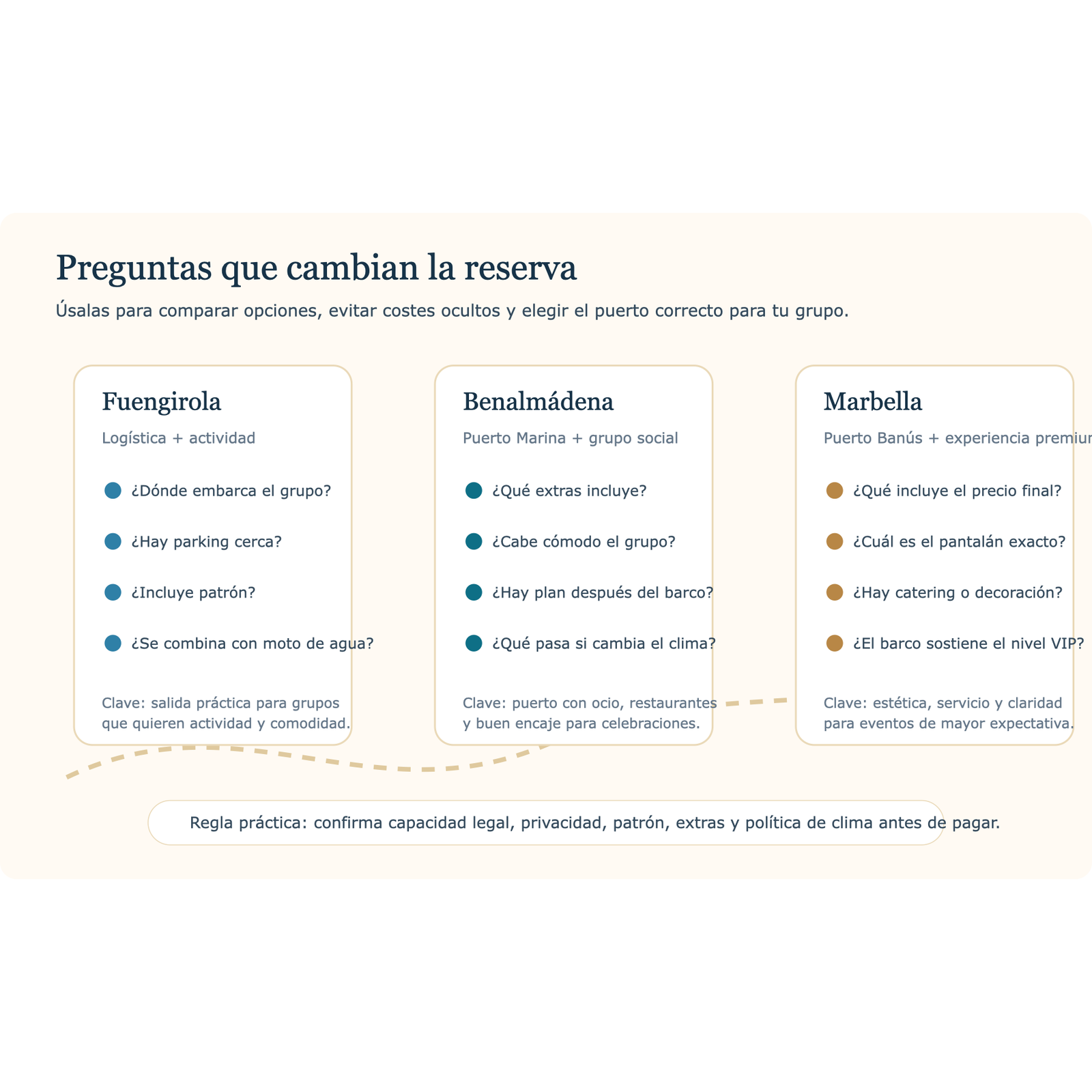
Although users often seek the same experience, the marketing logic shifts slightly depending on the departure point. In Fuengirola, the combination of accessibility, family tourism, and convenient departures tends to work very well. Benalmádena has established itself as a strong option for groups and catamarans. Puerto Banús and Marbella typically attract those seeking a more premium, visually stunning, and luxury-related environment. Málaga also serves as a regional umbrella and a dominant search point for users who haven't yet decided on a specific port.
That's why it's not advisable to book based solely on the destination name. It's better to book based on the desired experience and then adjust the port. This approach reduces errors and also helps make the sales conversation much more precise.
Practical checklist before moving forward
- Define how many people will actually go, not an approximate number.
- Specify if you are looking for relaxation, celebration, premium image, excursion or family activity.
- Please request in writing what is included, what is not included, and any possible additional charges.
- Confirm departure port, actual time and useful duration of the experience.
- Ask for a boat recommendation based on the group size, not just the budget.
- Check if the experience aligns better with a yacht, catamaran, sailboat, or classic private boat.
- It leaves room to address climate, changes, and group coordination.
If you're still filtering options, it's best to start with the Yacht Pro Spain's general offer, then go down to the guide of boat rental price in Malaga and contrast at the end the Fleet available on the Costa del Sol. This process allows you to compare budget, boat category, and actual value without mixing different products.
Frequently asked questions related
Does a higher budget always mean a better experience?
Not always. It means it might include more time, a better boat, more extras, or better service. The important thing is to compare on equal terms. Furthermore, it's always advisable to consider the type of vessel, the port, and the group's actual objective, because two trips with similar names can cater to very different needs.
Which hidden cost appears most often?
Fuel, skipper, final cleaning, or surcharges for special schedules. Furthermore, it's always advisable to consider the type of boat, the port, and the group's actual objective, because two trips with similar names can cater to very different needs.
Is it advisable to ask for several options?
Yes. Ideally, you should request at least three comparable proposals and review them using the same set of criteria. Furthermore, it's always advisable to contextualize the response by considering the type of boat, the port, and the group's actual objective, because two trips with similar names can serve very different needs.
Does the port have an influence?
Yes. Puerto Banús tends to drive up prices due to its premium profile. Fuengirola and Benalmádena may offer different balances between price, capacity, and type of excursion. Furthermore, it's always advisable to consider the type of boat, the port, and the group's actual objectives, because two excursions with similar names can cater to very different needs.
Which budget tends to be more stable?
Choose boats with clear specifications, written terms and conditions, and a supplier who explains exactly what you're buying. It's also always a good idea to consider the type of boat, the port, and the group's actual purpose, because two trips with similar names can have very different needs.
What questions should you ask the supplier before deciding?
There's a clear difference between asking for information and making an informed purchase. A well-informed customer doesn't just ask if the boat is available or how much it costs. They ask what specific experience they're buying, what limitations the service has, and what variables might affect the final result. That kind of conversation quickly filters out the organized providers from the unprepared ones.
A good set of questions includes: what is the exact departure port, how many people would be comfortable, is the published schedule usable sailing time, what happens if the weather changes, what extras can be added, who will be the operational contact on embarkation day, and what is an honest recommendation based on the group type. When a supplier answers clearly, it reduces uncertainty and facilitates a more confident purchase.
It's also worth asking what type of customer typically enjoys that boat the most. This seemingly simple question forces the salesperson to move beyond generic talk and ground the proposal in real-world use. If the answer is vague or only mentions price, it usually lacks depth in the sales pitch. On the other hand, when the recommendation is tailored to a couple, family, event, group of friends, or company, the conversation becomes more meaningful.
Signs of a professional and well-structured proposal
A serious proposal is recognized by several details. The first is precision: the supplier identifies the ship, the port, the duration, the capacity, and the conditions without ambiguity. The second is consistency: what is promised in the conversation aligns with the logic of the ship and the plan. The third is anticipation: questions are answered before they become problems.
Another important sign is that they don't try to sell the same trip to everyone. A discerning operator knows that not all groups have the same needs. Sometimes they'll recommend fewer hours, other times they'll suggest a catamaran instead of a yacht, and in other cases, they'll take the experience to a different port. This ability to tailor the recommendation is a real competitive advantage and improves both conversion rates and customer satisfaction.
Documentation also matters. A well-organized service typically provides traceability: clear conditions, meeting point, boat information, operational manager, change policy, and defined payment method. There's no need to overburden the experience, but it is essential to provide sufficient structure so the client feels in control and secure before boarding.
Why this content helps you make better decisions
Users aren't just looking for ideas for a great day at sea. They want to reduce risk, compare options effectively, and feel confident they're making a smart decision with their time and money. That's why a well-designed guide isn't an isolated resource. It serves as supporting content within the Yacht Pro Spain system, enriches the homepage, reinforces the regional guide, and helps guide sales conversations toward more informed bookings.
In practical terms, this type of content also improves brand understanding for search engines and AI assistants. It answers real questions, clearly defines variables, organizes information into extractable blocks, and connects each question to a possible action. This structure increases the content's usefulness and improves its ability to be cited, reused, and understood in different search contexts.
How does this decision fit into a well-designed nautical experience?
A successful booking isn't just about finding availability. It depends on the experience being perfectly aligned from the start. In the nautical world, that means the boat, the port, the duration, the crew, and the client's expectations all working in the same direction. When that alignment exists, the service is perceived as easy, premium, and reliable. When it doesn't, doubts arise, last-minute adjustments are made, and the booking feels confusing.
From a user's perspective, the best content isn't the one that repeats a keyword, but rather the one that reduces uncertainty. That's why this type of guide plays a supporting role within the system: it helps users understand what questions to ask, what to compare, and how to move toward a more informed booking. This also strengthens the content's quotability because it answers specific questions with a clear structure and direct responses.
Conclusion
The best decision when comparing boat rental quotes on the Costa del Sol isn't about improvising or going straight for the price. It comes from understanding the actual use of the boat, the group's profile, the appropriate port, and the specific service conditions. If the user clarifies these variables before booking, the experience improves significantly and the purchase becomes much more secure.
If you want to move from comparison to a useful pre-selection, review specific options such as the Catamaran for groups on the Costa del Sol, he Cranchi Mediterranee 50 yacht in Puerto Banús or the card of Mami boat with and without license. This way you compare budgets based on real boats and not on abstract promises.
We help you choose without wasting time
If you're still comparing options, we can help you make a decision via WhatsApp based on the number of people, port, budget, and type of experience.
- Clearer comparison
- Most convenient port and ship
- Help before booking